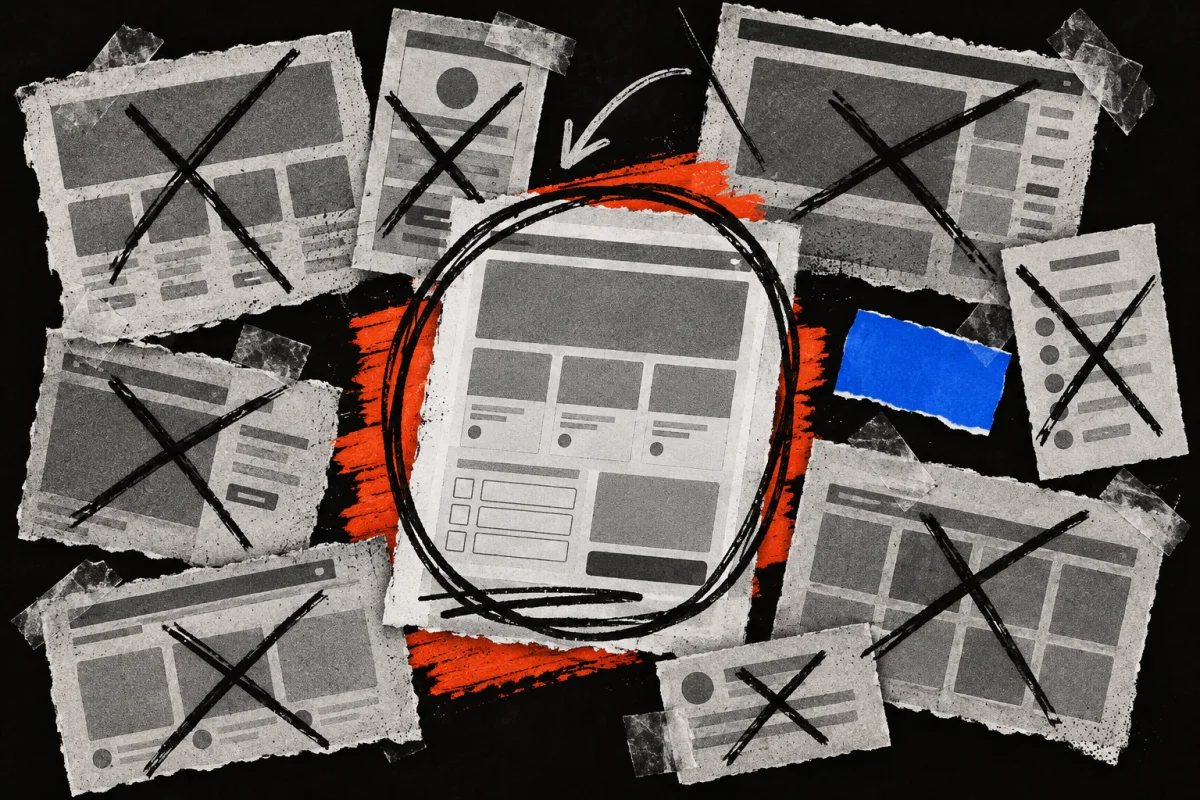
A lead generation landing page is one page, built for one offer, with one form and one thing it counts as a win. It is what someone lands on after clicking an ad, an email or a post, and its only job is to turn that visit into a name and a way to reach them. That is the only kind of page landflow makes, and the reason is a story about the first version of the product.
The first version of landflow could make anything. You described a site and it drew a site: a homepage, an about page, a pricing page, a contact form somewhere near the bottom. It demoed well. Almost nobody finished one.
When we read the logs, the pattern was embarrassing in its clarity. People opened the product with a campaign already in mind. They had an ad going live on Thursday. They needed one page with one offer and somewhere to put the email address. The five other pages we generated were noise they had to delete before they could publish.
What a lead generation landing page is, and what it is not
A website answers everyone who might arrive: customers, job applicants, journalists, the bank. A lead generation landing page answers one visitor who arrived for one reason, usually because an ad promised something specific. Everything on it is judged by whether it moves that visitor to the form.
That makes the differences concrete rather than stylistic:
- One offer. A landing page with four offers converts worse than the same page with one. If you have four, that is four pages.
- One form. A second call to action competing with it is a bug, not a preference.
- No exits it does not need. A full site menu is a list of ways to leave. In-page navigation that jumps between the page's own sections is fine.
- A known source. The visit came from somewhere you paid for or sent, so the lead should arrive knowing which campaign that was.
What a narrow product gets to decide
A builder that can make anything has to ask you everything, because it cannot know which of a hundred shapes you meant. A builder that makes one thing can decide, and the deciding turns out to be the part people actually wanted.
Because we only make a landing page with a lead form, we can assume things a general builder cannot:
- There is exactly one conversion goal, so every section can be judged against it.
- There is exactly one form, so a second call to action competing with it is a bug, not a preference.
- The form has a destination, so attribution and delivery are part of generation rather than a later integration. Every lead arrives with its source, campaign, click id and landing URL, which we explain in lead source tracking without a tag manager.
- The page is short enough to hold in one scroll, so in-page navigation is a real option and a sitemap is not.
Each assumption removes a question from the brief. What is left is the part only you know: what you sell, who to, and what counts as a win. Those are the same three questions that separate a publishable brief from a weak one, as we found when we read four thousand of them.
The parts of a lead generation landing page
Every one of the 196 templates in the landing page template library is a lead generation landing page, and their section lists show what the job needs. They run from eight sections to thirteen, and the same few parts recur because the visitor needs the same few answers:
- The offer, in the first screen. What it is, for whom, and the one action. Not a slogan.
- The detail that makes it believable. What is included, how it works, what it costs or when it happens.
- Proof the reader can check. Who else chose it, what they said, what the place or product looks like.
- The objections, answered. Usually as a short set of questions near the form.
- The form, asking only for what you will use.
The shortest pages show how little you need when the offer is clear. Course Enrolment has eight sections, seven photographs and an enquiry form with booking. Developer Tool has eight sections, nine photographs, an enquiry form and a pricing table. The longest, such as Record Launch Campaign with thirteen sections and twenty-six photographs, are long because their material is visual, not because a lead page has to be long.
Enquiry form or order form
The win decides the form, and the form decides the page. Of the 196 templates, 106 carry an enquiry form and 90 an order form.
- If the win is a conversation, such as a booking request, a quote, a viewing or a demo, use an enquiry form. Quiet Luxury Stay is built that way: ten sections, twelve photographs, an enquiry form with booking.
- If the win is a sale the visitor can complete now, use an order form. Seasonal Kitchen has eight sections, twelve photographs and an order form for a short range.
A page that tries to do both usually does neither. If you need both, that is two pages, each behind its own link.
What we gave up
We are not a website builder and will not become one. If you need a documentation site, a store, or twelve pages of company history, we are the wrong tool and we would rather say so on the first screen than three hours in.
A builder that can make anything has to ask you everything. A builder that makes one thing can decide, and the deciding is what you actually wanted.
Giving that up is also what lets a page publish somewhere other than our own subdomain. Because the page is a single bundle, it can sit on your own domain, or on a page of your WordPress site through the landflow Connector for WordPress, while its form still posts to your landflow inbox.
The test we use now
Every feature proposal has to survive one question: does this help someone put a page behind an ad this week? Section reordering survived. Custom code in the head survived, because site verification needs it. A blog engine did not. A component library did not. A second form on the same page very much did not.
The same narrowness is why a page cannot go live with two forms, a broken anchor or an empty share image: the six checks we run before anything is published only make sense when there is one kind of page to check.
The product is smaller than it was a year ago and people finish pages with it. That trade has been worth making every single time.