A trust page for advice that takes time
Someone searching for a compliance trust page needs more than a list of credentials. They need to understand who is responsible for the advice, what sort of decisions the firm helps with, and how a first conversation begins. For a private-client adviser, a generic business page can make considered work look interchangeable. It may lead with services before it has established why the firm should be trusted with significant financial and family decisions.
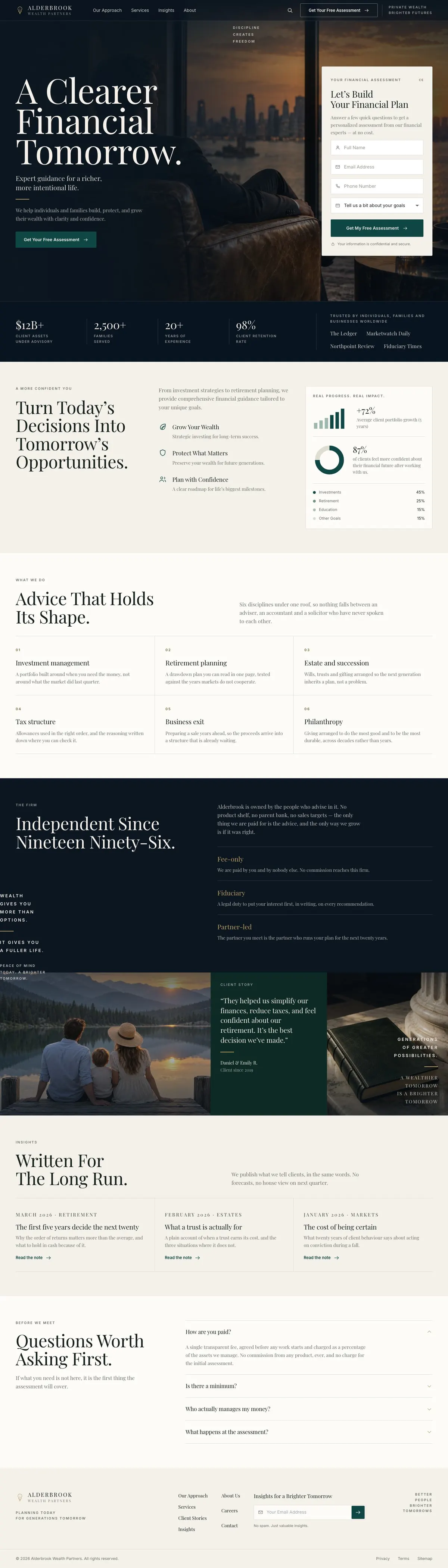
This design takes a different route. It places an assessment in the opening section, then makes room for the firm’s approach, its disciplines, its ownership and payment position, a client story, published thinking and early questions. The result is suited to an enquiry rather than a transaction. It gives a visitor enough context to decide whether an assessment is the right next step.
The template is not a replacement for compliance documentation or a technical privacy explanation. If the page needs to centre on data privacy rather than private-client advice, Data Privacy Platform is the closer related starting point.
A considered route from first impression to assessment
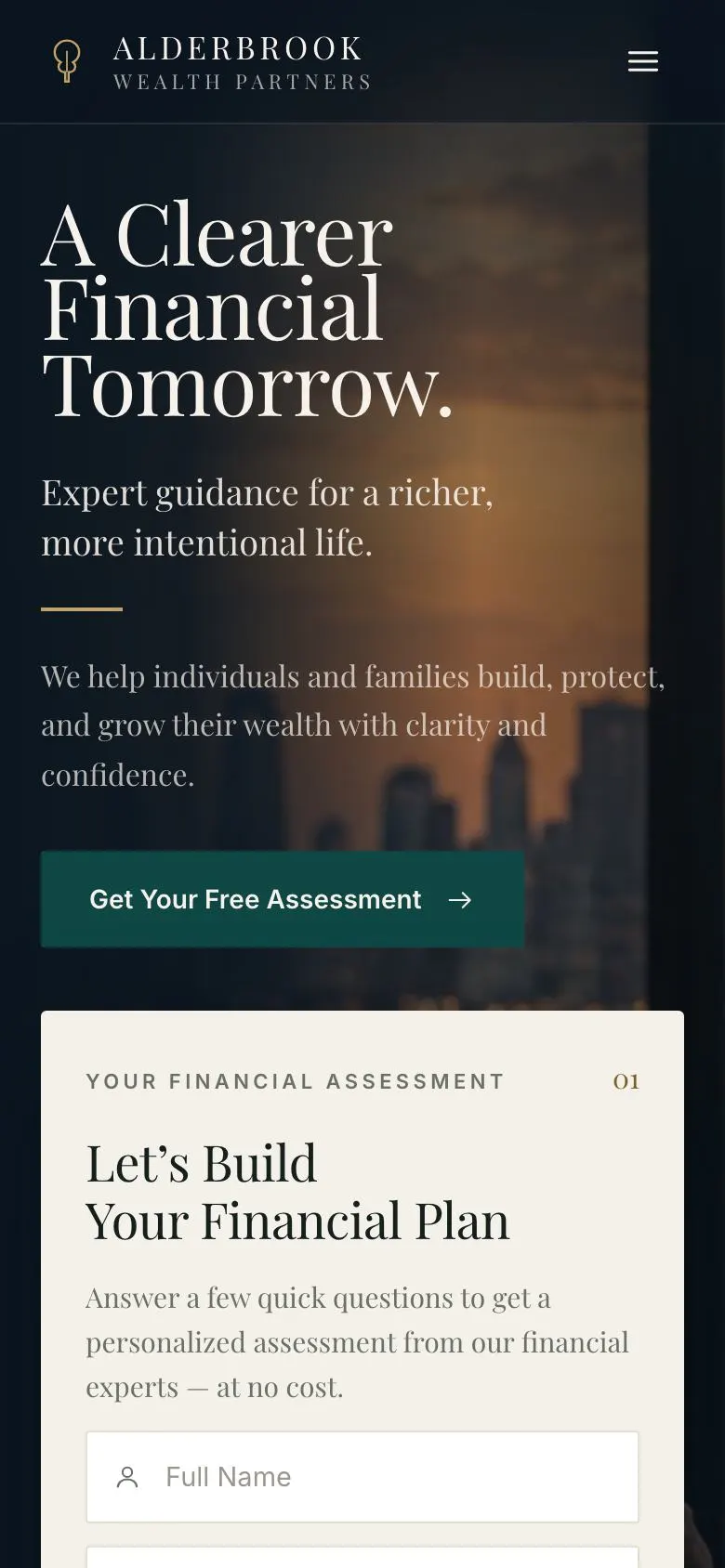
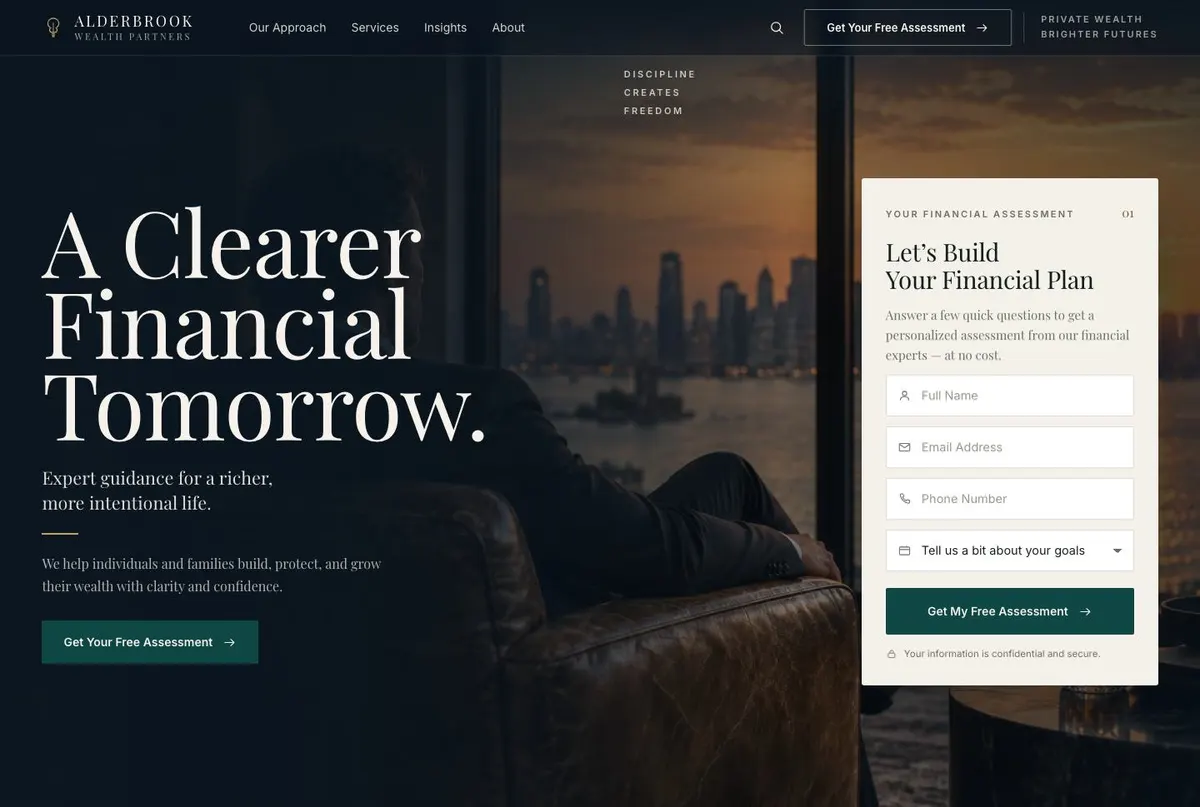
The page opens with the Hero, headed “A Clearer Financial Tomorrow”. It combines a photograph with an enquiry form and the call to action “Get Your Free Assessment”. This is where the firm should say, plainly, what the assessment is for. The opening copy needs to name the kind of guidance offered and the life decisions it can help clarify. It should not try to explain every service at once.
Trust follows. This is the place for the short proof points that help a visitor orient themselves before reading further. Use it for facts that are meaningful to a private client and that the firm can stand behind. Keep the language direct. The purpose is not to make broad promises. It is to establish the terms on which the firm works.
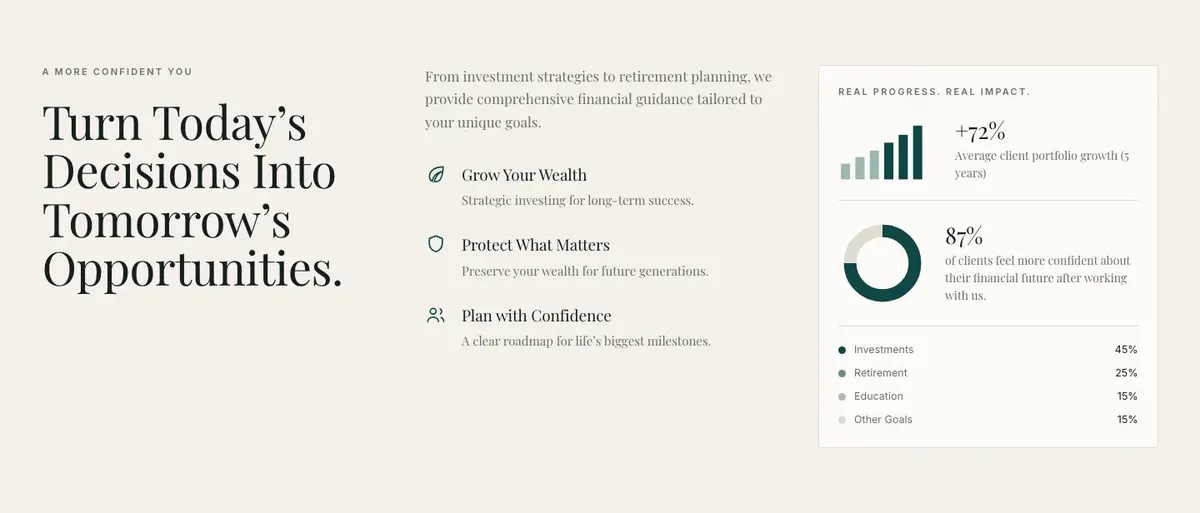
The Approach band, led by “Turn Today’s Decisions Into Tomorrow’s Opportunities”, is where the firm explains its view of joined-up financial guidance. Its supporting line refers to investment strategies and retirement planning, but the template should be adapted to the actual work offered. The items here should describe the decisions that require coordination and the way the firm brings them into one conversation. This is useful when prospects have several advisers or concerns that do not sit neatly in one category.
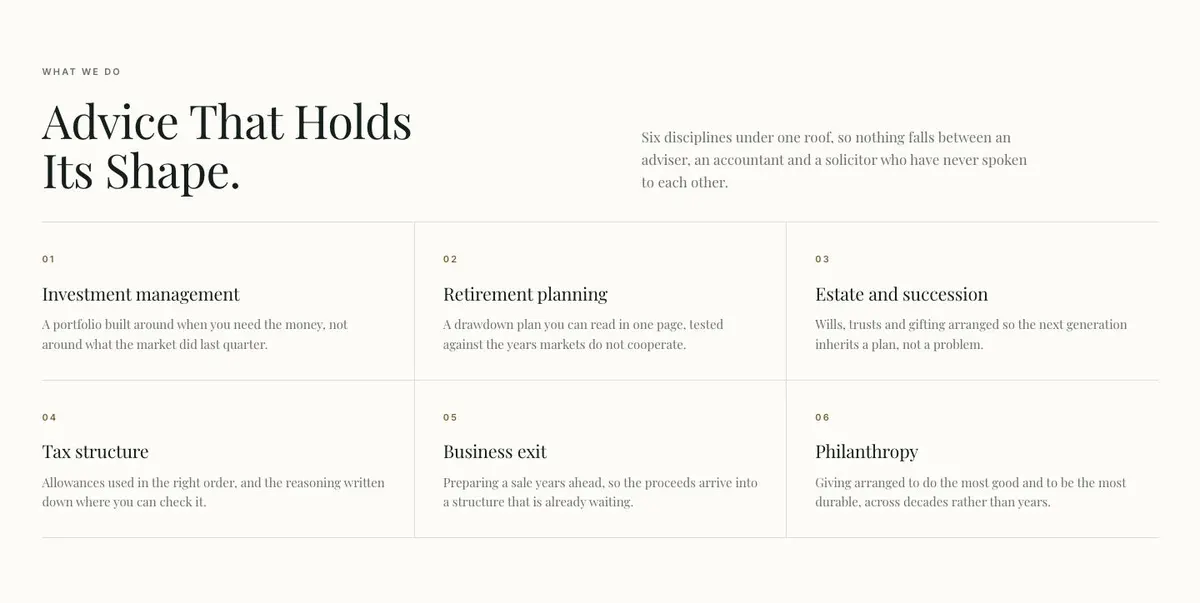
Services gives that argument more structure. “Advice That Holds Its Shape” frames the work as connected disciplines rather than isolated products. Write each discipline as a clear area of advice. Avoid adding a service merely because competitors mention it. The page works best when each item reflects work the firm can genuinely deliver and when the relationship between those areas is explained in the supporting copy.
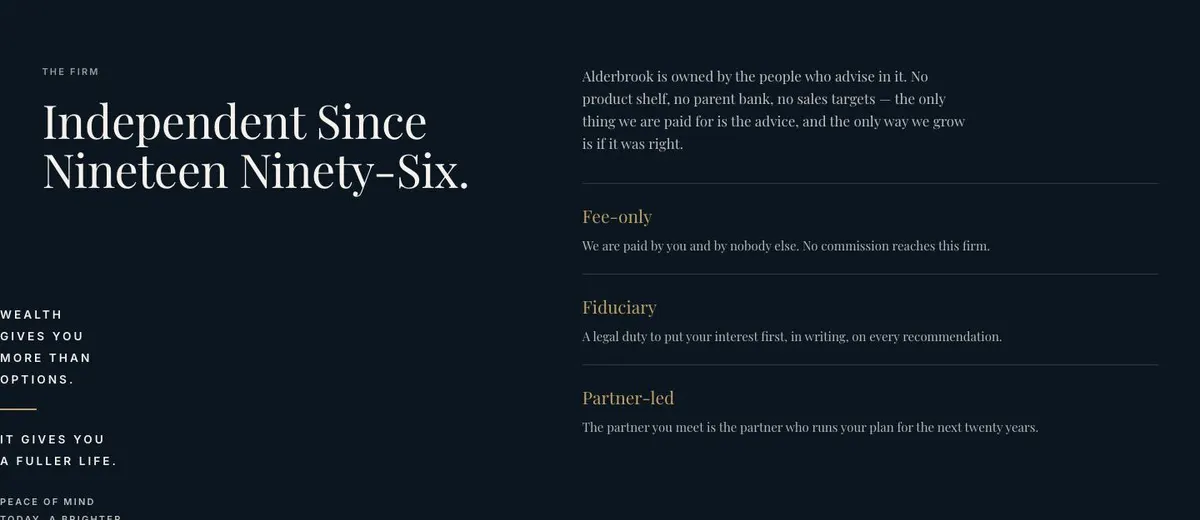
The About band is one of the most important parts to make specific. Its current heading, “Independent Since Nineteen Ninety-Six”, and its copy focus on ownership, no product shelf, no parent bank, no sales targets and being paid for advice. A firm using this template should replace those statements with its own accurate position. This is where a visitor learns who owns the practice, what guides its recommendations and how the firm describes its commercial relationship with clients.
Stories then gives the page a human centre. It contains a client story, a quotation and photographs. Use a story that shows a real type of situation without exposing information that should remain private. The point is to show the shape of a relationship and the value of continuity, not to present a result as typical or guaranteed.
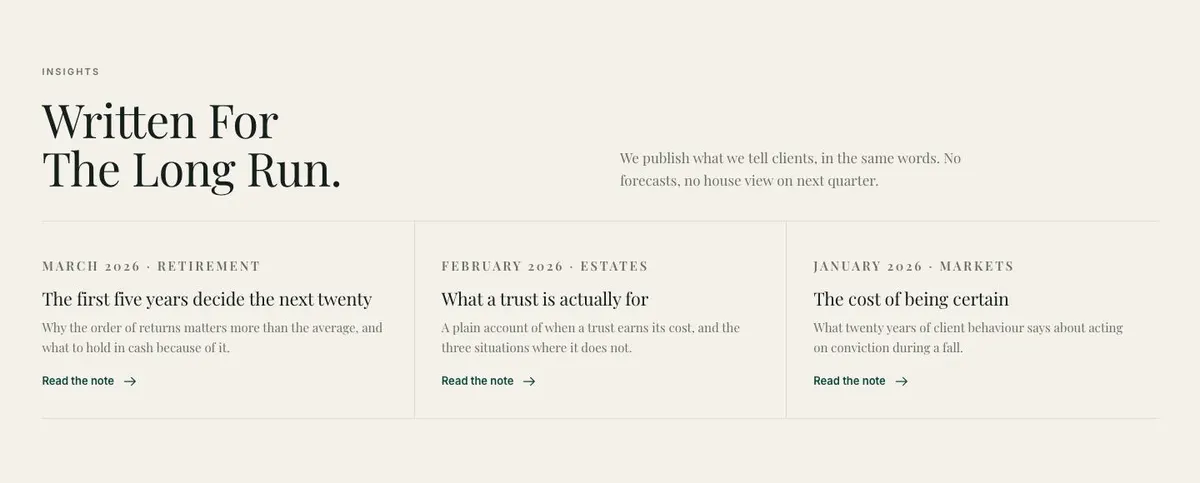
Insights, headed “Written For The Long Run”, makes space for three pieces of published thinking. The existing line rejects short-term forecasts and a house view on the next quarter. Keep this band only if the firm can maintain it with material that reflects its own voice. The articles should help a prospective client see how the firm thinks before they enquire.
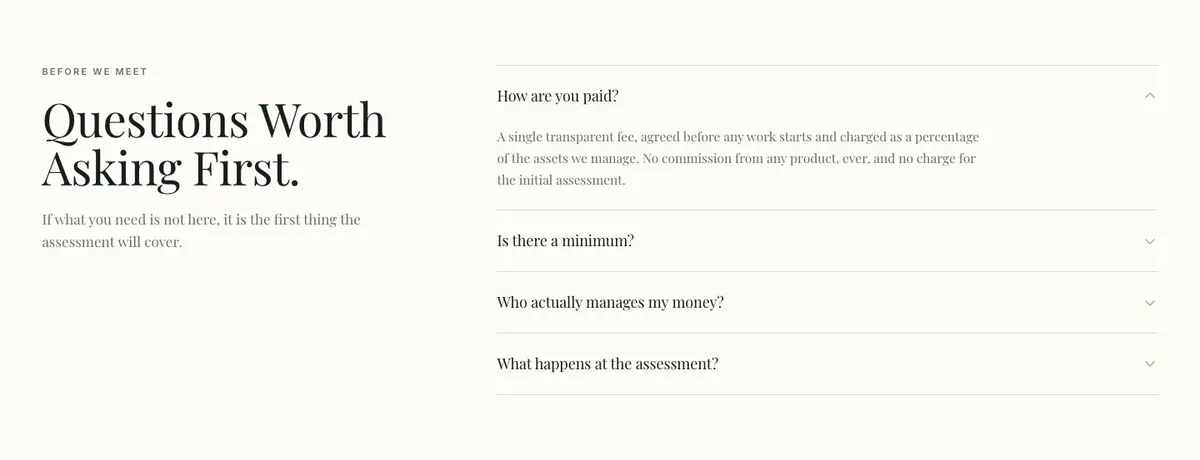
The final Questions band, “Questions Worth Asking First”, combines an accordion with an enquiry form. It is the place to address the practical questions that delay a first call. The line beneath it makes a useful promise: where a question is not covered, the assessment will cover it first. Match the questions and answers to the firm’s actual process, then make the form the calm next step rather than an abrupt sales prompt.
Adapting the editorial direction
The design is available in Forest, Navy, Claret and Ink. Choose one that fits the firm’s existing identity, then use it consistently across the page rather than treating the scheme as a substitute for clear writing. The overall direction is light, serif, photo-led and editorial, which suits a practice that wants to publish considered views alongside its advice.
Playfair Display is the display face and Inter is the body face. The available pairings also include Cormorant Garamond with Inter and Hanken Grotesk with Inter. A business should choose a pairing that remains consistent with its wider materials. The page needs three photographs: one in the Hero and two in Stories. Prepare images that can support the opening introduction and the client-story section without asking photography to prove claims the copy cannot support.
Writing the first version for the firm
Starting from a template costs no credits. Rewriting the copy with AI costs about 20 credits. A useful brief names the business, the people it serves, the advice it offers, the reason clients choose it and the one action the page should produce. It should also state what must not be claimed, particularly around independence, ownership, fees, outcomes and any regulated wording.
Give the AI the raw material it needs: a short account of the assessment, the actual disciplines offered, the firm’s history and a suitable anonymised client situation. Name the tone required as well. For this template, concise and measured copy will usually fit better than promotional language. The final version should still be checked by the people responsible for the firm’s client communications.
What to prepare before publishing
Write the opening explanation of the assessment and decide what “Get Your Free Assessment” means in practice. Prepare the short trust statements, the approach items and the service descriptions. Confirm the wording for ownership, independence and how advice is paid for before it appears in About.
Also prepare one client story, a quotation that can be used, and three insight subjects or published pieces. The Questions band needs answers to the issues clients raise before they commit to an assessment. Finally, select the three photographs and make sure the enquiry form leads to a response process the firm can actually maintain.
Useful variations for neighbouring practices
A financial planning practice can make retirement planning, family planning and long-term financial decisions the centre of Approach, then use Services for the specific advice areas it provides. Its client story can focus on a planning relationship rather than an investment outcome.
A private bank can use the same structure to explain how it coordinates decisions across a client’s circumstances. It should make About precise about its own ownership and advice model, rather than retaining the sample position.
A law or accountancy practice with private-client work can adapt the disciplines around the matters it handles for families and individuals. The assessment language should become a first consultation or review only if that is what the practice actually offers.
When a different starting point is closer
For a service business that needs to explain a business process rather than private-client advice, Warm B2B Workflow may be a better fit. Quiet Ledger is worth reviewing for a different finance-led direction. For technical services, see IT Solutions. If the subject is property rather than financial advice, Estate Agency is the more relevant neighbouring template. Browse the saas template hub for further starting points.
Before the page goes live
- Check that every statement about ownership and payment is accurate.
- Make the assessment offer match the firm’s real first step.
- Use a client story that protects private information.
- Read every answer in Questions as a prospective client would.